

Manos de Dios
Scholarship Program
Background
When we first started working in Honduras back in 2000, it did not take us long to realize that the colonia of Nueva Esperanza in Danli was facing many challenges such as high unemployment rates, poverty, poor housing conditions, presence of gangs, lack of role models, and a high percentage of school dropouts, among many other issues. As we explored our options to start addressing some of these issues, we discovered that there was one answer to these problems…education.
According to UNICEF, 89% of Honduran children in elementary school age are enrolled in school, however, that number drops to about 39% when it comes to middle school. Addressing this issue was the premise of the Manos Scholarship Program back in February of 2001.
The original idea was to offer a scholarship to low income highly motivated students that had finished 6th grade and could not afford to stay in school. However, it came to our surprise that as the first couple of scholarship recipient students graduated from high school, they asked the question “Is there any way that you could help us go to college”? We were thrilled to see that our students had not only graduated from high school but wanted to further their education. After this, we decided to expand the program in order to help some of these very well deserving students and give them the opportunity to go to college.
In 2010, we introduced an extension of the Manos Scholarship Program called Becas to Go. This program awards two scholarships per year to qualified students who live in the surrounding remote villages where the education level does not go past the 8th grade. The students awarded these scholarships have to relocate to Danli and live with relatives or with a family that is willing to sponsor them during their schooling in Danli.
Impact
The Manos Scholarship Program currently has 57 students: 36 students in grades 7-12K and 21 students in college.
A total of 21 students have graduated from college from a wide range of areas including Civil Engineering, Agronomy Engineering, Industrial Engineering, Forestry, Medicine, Nursing, Law, Marketing, Nursing, Law, Psychology and Computer Science. Most of our college graduates are currently working and able to help their families.
Throughout the years Manos has been able to impact over 250 families in Danli and over 20 families living in remote villages within three hours of Danli.
There are different opportunities for total or partial sponsorship for one student for one academic year. We have sponsorships for a student in grads 7th-12K and for college as follows:
-
$50 - helps sustain our program
-
$150 – co-sponsors one 7th-12th grade student*
-
$300 – sponsors one 7th-12th grade student for one year*
-
$500 - co-sponsors one college student**
-
$2,500 – sponsors one college student for one year**
-
*Covers uniforms, books, school supplies, shoes, transportation, internship and graduation expenses.
** Covers enrollment fees, tuition, books, internship and graduation expenses.
Needs
Club Aventura
Background
In January 2015, Manos started a book club called Club Aventura with the intention of encouraging our scholarship students to read and discuss books with their peers and discover the joy of reading. The notion of book clubs is not really something that our students in Honduras have been exposed to as part of their upbringing, either at school or at home. During the first few years of Club Aventura, the students have read all kinds of books including a wide range of authors such as Isabel Allende, Paulo Coelho, Markus Zusak, Sandra Cisneros, Julio Verne, Edgar Allan Poe, Lorena Franco, Gustavo Adolfo Becker, Julia Alvarez, Pablo Neruda, Ramón Amaya Amador, Carlos Ruiz Zafón, Charlotte Betts, and Shakespeare. A couple of years after starting the Club Aventura, we were able to introduce Kindle tablets. The use of tablets has allowed us to provide a wider range of authors and books to our students.
We originally started Club Aventura I with about 10 students, and in 2020 we launched Club Aventura II as we had more students that wanted to be part of this wonderful opportunity. In addition, our partner school Centro Técnico Vocacional Pedro Nufio, where our scholarship students attend grades 7th-12th, decided to expand Club Aventura as a school wide effort with over 40 students signing up for the program.
In January 2019, we held a session with Club Aventura where we had an opportunity to discuss via Skype the book “El Secreto de mi Turbante” with the Afghan author Nadia Ghulam, who is currently living in Spain. It was amazing to see the depth of the discussion, especially as the students had never been exposed to a book that dealt with the hardships of growing up in Afghanistan during the Taliban regime.
In January 2020, both Club Aventura I and II read the same book “The Boy Who Harnessed the Wind” by William Kamkwambe. This is a story about a thirteen-year-old boy in Malawi who invents an unconventional contraption to save his family and village from famine. Interestingly, enough, the students were able to make parallels between their lives in Honduras and life in Malawi.
Impact
Needs
-
$100 – pay for six e-books
-
$140 – pay for one Kindle


Club Intercambio
Background
As our Manos Scholarship Program students graduate from high school and college, we have noticed that they experience a disadvantage compared to students from other schools that might have been more fortunate to learn English as a second language. Given this situation, in March 2014 Manos decided to start an English as a Second Language (ESL) program for our scholarship students named Club Intercambio. Each Saturday, Club Intercambio students get together for a three-hour ESL class with two certified ESL Honduran teachers.
Over the years, our program has grown and that is reflected in the way this program has been implemented. In addition to our Saturday classes, we also incorporate Intercambio as part of our January mission trips.
Impact
Manos has been able to teach English to about 50 students from our Manos Scholarship Program as well as some members of the community. Students have been able to improve their language skills from Beginner to Intermediate levels, with some students even reaching a more advanced conversational level.
In April 2022, the Manos Ministry created an alliance with the Department of Bilingual Bicultural Studies at UTSA. UTSA graduate students enrolled in the Technology in Language Teaching and Learning course, got a global exposure to teaching English as a second language to our Manos Scholarship students. This course was taught by associate professor Kathryn Henderson, Ph.D., with the assistance of John Turnbull, a Ph.D. candidate studying culture, literacy and language. The Buddy/Amigo program included UTSA graduate students providing virtual lessons to our Club Intercambio students.
Dr. Henderson believes that the Manos and UTSA partnership aligns well with the College of Education and Human Development's vision statement to "train culturally and linguistically responsive agents of change". She adds “students are gaining skills and practice, but also having that cultural interaction and exchange where they are able to increase the other skills that we want in our students”.
*Quote originally published in an article by UTSA College of Education and Human Development news: "UTSA grad students partner with mission outreach to teach English remotely" by Christopher Reichert* READ HERE
Needs
-
Volunteers willing to participate in the “Visitas Virtuales” Intercambio Program.
-
Each volunteer will be able to participate in a remote class helping our Intercambio/ESL students.
-
No official ESL training required. The purpose is to engage the students in casual conversations about daily topics (e.g., pets, family, school, culture, food, history, music, art, etc.) and help them practice their English conversational skills.
-
Time commitment: 1-2 hours every 4-6 weeks.
-


Brillantes Program
Background
In October 2021, a new K-12 STEM education program called Brillantes (Brilliant Ones) was implemented in Danli, Honduras. This program was initially developed at Texas State University by Dr. Araceli Ortiz and Ms. Cindy Rojas. Earlier in 2021, the Manos Scholarship Program (Manos) started working with Professor Araceli Ortiz. Since then, Dr. Ortiz works for the University of Texas at San Antonio (UTSA) as the endowed program director of Engineering Education in the Klesse College of Engineering and Integrated Design and has continued supporting our efforts in her new capacity. In 2022, Dr. Alejandra Sorto from the Mathematics Department at Texas State University have also joined our efforts.
The Brillantes Program is an electrical engineering and algebraic reasoning out-of-school program. We held five 4- hour (in 2021) and five 4-hour (in 2022) sessions on Saturdays at the Manos de Dios Episcopal Church in Honduras. The in-country team was formed by a secondary Mathematics teacher, two Industrial engineering students as teaching aides, and two coordinators in charge of the logistics and IT areas, respectively.
The objectives of the Brillantes Program is to:
1) Provide motivating and enriching STEM learning experiences to underserved students.
2) Pilot a new integrated program with Honduran students with the potential to replicate the program in other Spanish speaking communities in the US and/or in Latin America.
3) Provide professional development to Honduran educators and facilitators.
Impact
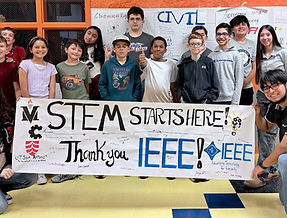
The Brillantes Program was implemented among 20 Manos Scholarship Honduran students in 7th, 8th, and 9th grades in 2021. In 2022, the Brillantes Program was offered to a new cohort of middle school students in 7th, 8th, and 9th grades. In August 2023, we will implement the Brillantes Program for a third consecutive year with a new set of students. Since 2024, Brillantes has continued to develop its curriculum with the help of professionals from The University of Texas at San Antonio and Texas State University. Manos has had the privilege of witnessing scholarship students become professionals and offer a hand in teaching the next generation of Brillantes students.
In 2026, in collaboration with our partners at UTSA, Manos was able to participate in the implementation of a Brillantes STEM camp in Texas! Basing ourselves off of the successful curriculum developed and piloted in Danli, Honduras, Manos was able to adapt the the program for a Spring Break camp at the Castroville High School campus. Thanks to UTSA's professor Dr. Araceli Martinez and two UT San Antonio Grad Students, as well as experienced public school teachers, we were able to serve over twenty students for the duration of the camp.
Grants
The Brillantes Program has been made possible due to three grants that the Manos Honduras Ministry received from the Institute of Electrical and Electronics Engineers (IEEE) and the Petroleum and Chemical Industry Committee (PCIC).


Cyber Cafe
Background
Manos Cyber Cafe was born out of an idea to create a space for our students to access computers and programs in order to increase their knowledge and skills in the competitive environment that is the university. Our desire to create a computer lab was matched by God's providence through our Manos scholarship college students and graduates who are experts in the field of Computer Science. We decided to take God's gifts and launch this program.
With the help of committed ministry members and a grant provided by the World Mission Board of the Diocese of Texas, we were able to bring this vision to life. After months of planning and coordinating with our in-country team members, we created a leadership team for Manos Cyber Cafe that was ready and willing to commit time for a series of engaging and exciting computer classes.
Our instructors planned for an initial hybrid methodology where our lead teacher connected virtually and assistant instructors assisted worked with students in person.
Impact
Our inaugural class for Manos Cyber Cafe consisted of high school seniors intent on attending college after graduation. With their participation in this program, they would obtain the skills required to help them in the classroom as well as give them a competitive edge among their peers. Additionally, the benefits would cascade to the following classes through encouraging these students to share the knowledge and pass on the skills that they acquired.
Through comprehensive pre and post tests designed by our lead teacher, Alejandro Carcamo we were able to have a clear picture of the impact and benefit of this program.
Students who did not have an adequate understanding of computers and programs prior to committing to this class are now equipped with exceptional knowledge that will aid them in their pursuit of a college education and a better life.
In summary, the students who scored below 65% on their pre test were able to score close to 80% or above on their post test evaluation with two students scoring in the 90s.
These evaluations covered knowledge on computer peripherals, programs, and fluency.
Needs
-
Volunteers willing to participate in the Cyber Cafe Program.
-
Each volunteer will be able to attend the hybrid classes as observers or participants.
-
No official computer class training required. The purpose is to engage the students in casual conversations about relevant topics and help them practice their English conversational skills.
-


Grants
This program was made possible through a grant provided by the World Mission Board of the Diocese of Texas.